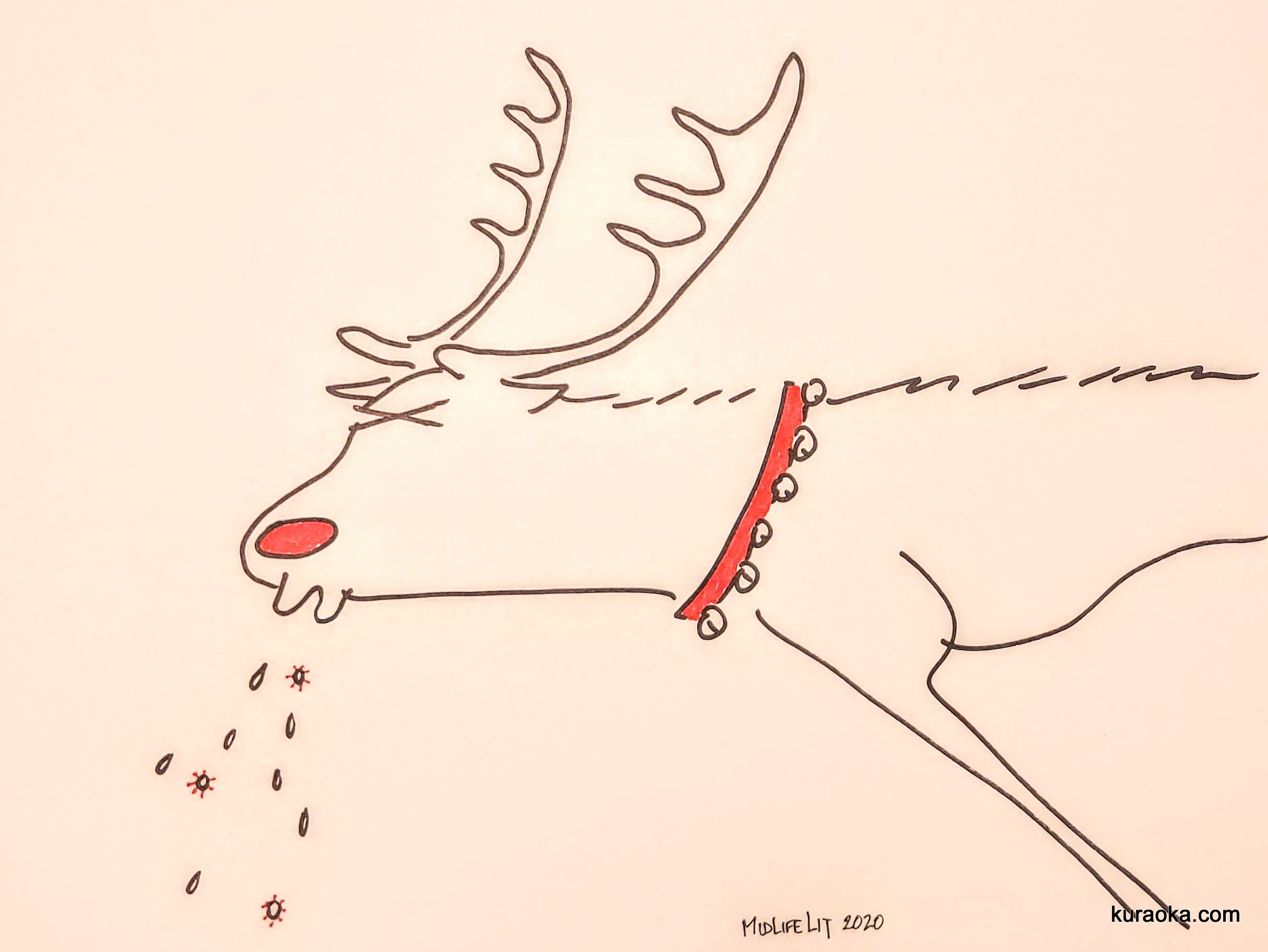
I drew this and it just made me laugh:
Quick finder (main website):
Home
| Advertising portfolio | Brochure portfolio | Services | Experience | FAQ | Advice
| About me | Contact
Quick finder (advertising blog only):
Ad Blog main page | Monthly
archives | Ad Blog FAQ
December 24 2020
I drew this and it just made me laugh:
Of course, then I had to write the lyrics to “Grandma Caught Corona From a Reindeer” sung to the tune of “Grandma Got Run Over By a Reindeer” by Randy Brooks. That abomination, though, I stashed elsewhere. The thumbnail also works for “Rudolph the COVID Reindeer,” or, well, just make up your own. Happy Holidays and best wishes for a healthy and happy 2021!
November 16 2020
This article about the AMC Marlin just came across my feed, and I just had to post about it somewhere. Don’t worry; I will get round to advertising:
Advertising copywriter blog link
The writer of the article doesn’t seem to be a fan, but I am. The Rambler/AMC Marlin was one of my childhood favorite cars (even as a kid, I was attracted to the outliers and oddities). I still think Marlins look cool.
The 1965 Marlin was American Motors’ response to the 1964 Ford Mustang fastback, but it became something unique. The sleek design, based on the mid-sized Rambler Classic, was somewhat compromised by Roy Abernathy, the 6-foot-4 inch AMC CEO, who insisted that he be able to sit in the back seat of the design mules. As a result, though, when it hit the market the Marlin was a true six-passenger luxury sports coupe unlike anything else at the time. (Speaking of which, automotive passive restraint and structural safety systems have advanced to the point that it’s nearly time for bench seats to make a comeback.)
The article mentions AMC’s proto-sustainability message in its advertising, and the line “The Only Race Rambler Cares About, is the Human Race.” Variations on that theme have found their way back
into advertising a few times. Once was in the 1970s for People’s Bank of Seattle – “Member FDIC and the Human Race” – written by my mentor, Mark Doyle. Another was in the late 1980s for
Nissan: “Built for the Human Race.” Actually, that similarity stirred up some controversy, because the agency responsible for both lines, albeit ten years and many staffing changes apart, was Chiat/Day.
But, as Mark was quoted in this article about the kerfluffle, “no one can claim ownership to the words, ‘the human race’.”
Advertising copywriter blog link
It’s just another example of a concept being in the wings, ready to infect those disposed to catch pre-emergent trends, like artists and advertising creatives. I call them airborne ideas. Like viruses, these ideas cycle predictably, tend (except for nostalgia) to be more affected by background environmental factors than a fixed timeline, and can strike many people at once.
But, back to Marlins!
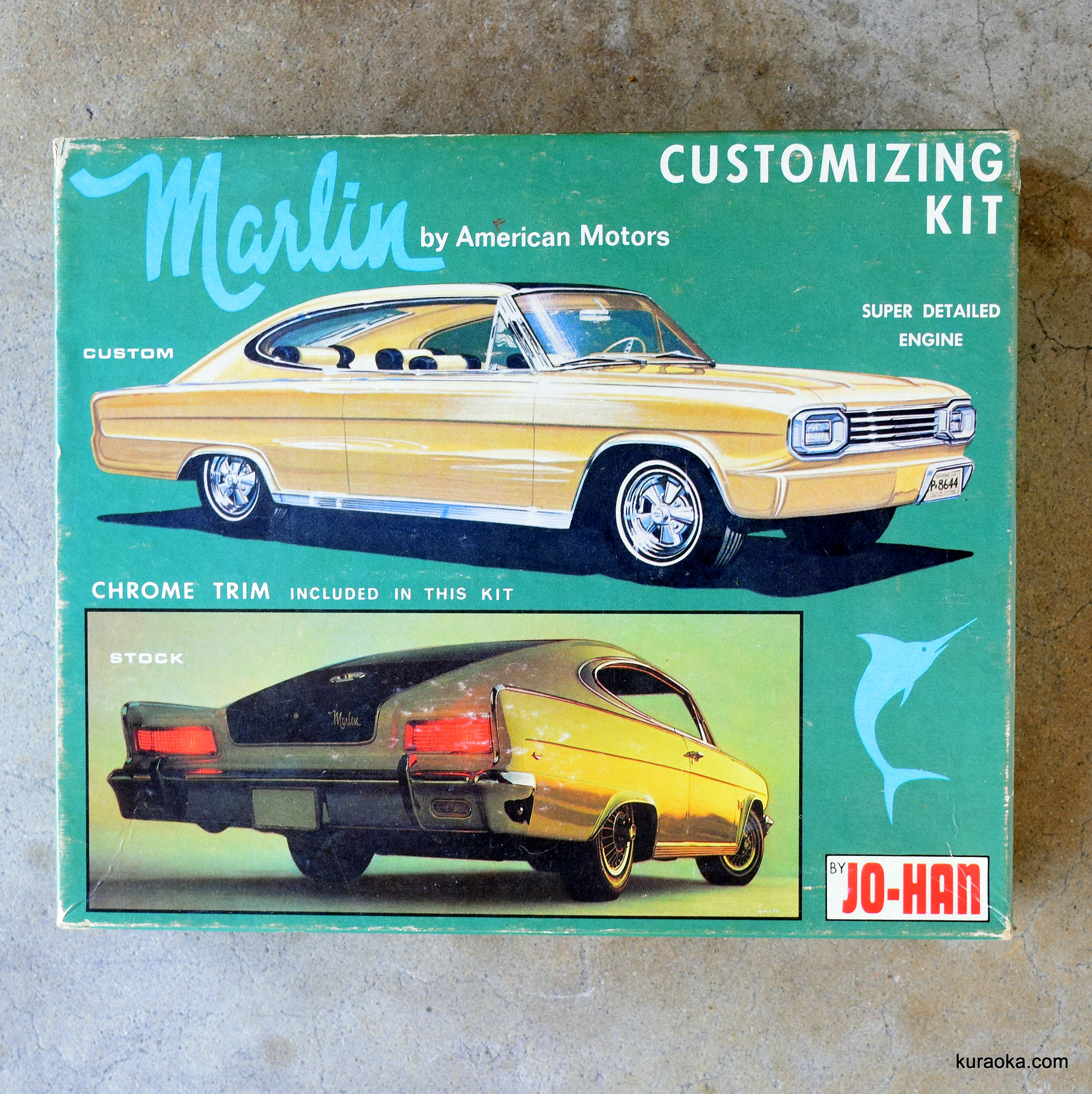
Here’s my ancient (and as-yet unbuilt) model kit of the first-generation Marlin. It’s based on promotional models made by Jo-Han for AMC dealers. Somewhere I also have a Corgi die-cast toy car version, in
two-tone red and black. Corgi also made a somewhat rarer blue and white model, which was part of a boxed set. Note that the box says “Marlin by American Motors,” not “Rambler Marlin.” That was a deliberate
act by AMC management, to distinguish the would-be halo car from the brand better known for sensible smaller cars like the Rambler American and the Rambler Classic. We would see this tactic again, sometimes
in an effort to reach up and other times in an effort to reach down (the ill-fated “Cimarron by Cadillac”).
The second-generation Marlin, based on the larger AMC Ambassador, was a single-year model in 1967. AMC head designer Dick Teague said the second-gen Marlin, on a longer wheelbase with stacked quad headlights, was the best looking one, but no toy versions exist that I know of.
I disagree strongly that the Marlin was AMC’s Edsel; yes it was an attempt to move up-market and it lasted only three years, but in most other significant ways it was the opposite of Edselian.
The history of AMC still intrigues me. It’s proof that intelligently designed, higher quality products supported by clever advertising (by Wells, Rich, Greene and others) still can’t reverse a
prevailing trend toward the increased acquisition of individual (horse)power. Sadly, selfishness almost always wins.
Back to the top of the page
February 1 2020
Real estate agents are tuning into the power of copywriting. Here’s the story, from The Philadelphia Inquirer:
Advertising copywriter blog link
An academic study of more than 700,000 home listings and sales over ten years revealed big differences in sales speed and price attributed to word choice in the property description. Good words: “adorable” (5% better chances of a sale), “gorgeous” (1.44% better), and “awesome” (1.02% better). Negative words included “investment,” “distressed,” and, proving that people are herd animals, “reduced,” all of which decreased value and increased time on the market.
The biggest shift word was “adorable,” which, when applied to a small house, added $43,000 or more to the home’s value. The wrong word choice, by contrast, could reduce property value by up to $60,000.
Somewhat surprising to the researchers, although probably not to either a tuned-in real estate agent or a professional advertising copywriter, was the negative effect of trigger words like “luxurious,” “large,” and “spacious.” Those are qualities best shown rather than cast in type.
So, does copywriting add value? Absolutely, and here’s mathematical proof.
Back to the top of the page
September 25 2019
Aaand yet another economic group sounds the alarm. The United Nations trade and development group issued a report predicting a global economic slowdown. Here’s the story, from
The Guardian (UK):
Advertising copywriter blog link
I think the current U.S. economy, driven by short-sighted environmental and regulatory rollbacks and bipartisan manipulation of interest rates and commodities, has borrowed just about all it can from the future. That the future is calling in the loan should come as a surprise to no one, because we’ve been here so, so many times before.
Story minute. Many, many years ago, I helped create ad campaigns for a bank. With my art director partner, I wrote the bank’s home-equity loan and line of credit ads. We did a lot of fun stuff, stuff that broke through the clutter, won awards, and attracted business. The ads were so effective, our client actually had to add phone reps to handle the load of incoming calls.
Several years later, the housing meltdown happened, leading to a mortgage meltdown and a huge financial mess. Between their mortgages and their home equity loans, people owed more on their houses than the houses were worth, and as the economy contracted, people lost their jobs, couldn’t make their loan payments, and lost their homes. The banks got bailouts. But ordinary people got nothing, and tightening credit rules made it even harder for them to keep a roof over their heads.
I had friends who lost their homes.
Flash forward to a year or two ago. I was approached by a potential major new client that wanted to hire me as a freelance creative director for a new advertising project. The client was a bank. The project was an integrated ad campaign – print, radio, TV, direct mail, and online – rolling out a new home equity loan product. Ayup.
I said no thanks, I’ve been here before.
But, honestly, if the experts don’t learn from the past, what hope do ordinary consumers have?
Back to the top of the page
September 20 2019
For an advertising copywriter, the right word in the right place can make a huge difference in effectiveness. In some other professions, though, the right word saves lives. Here’s the
story about word choice and its effect on clinical outcomes, from BBC Future:
Advertising copywriter blog link
Ad copy – carefully written ad copy, anyways – uses loaded words (like “home” and “family”) to conjure out of thin air historical context and positive associations with products and brands. So it’s important to tune into the social connotations of words, like the difference between “talk” and “speak,” and use the right one for the job.
I found the use of the negotiating phrase “are you willing” to smack of old-school salesmanship, but here again, I think scientific studies are only just catching up to where advertising and sales people have long been. But the massive difference in effectiveness between “something” and “anything” will have me tweaking my own pitch.
By the way, I write ads. Is there something you need done?
Back to the top of the page
September 4 2019
I have two for you today. My first story is about pop star Ariane Grande suing fashion retailer Forever 21, possibly into bankruptcy, over images Forever 21 created and used in an ad campaign
that Grande says falsely make it appear she endorses the brand. Here’s the story, from MSN.com:
Advertising copywriter blog link
To my not-an-IP-lawyer eye, the lookalike photos go past homage or parody but fall short of impersonation. I sorta-kinda doubt anyone more into Ariane Grande than a casual observer would be fooled for much longer than a double-take. And yet, that seems to be the point of Forever 21’s campaign, to make use of a known star’s latest visual tropes to entice a slightly longer look at an ad.
Conversely, though, are we to say that Grande has a trademark now on long ponytails? On pink and purple neon? On camo fatigue pants? On a style of photography or posing, or even ethnicity fercryinoutloud?
Let’s look at a counter-example with even more-familiar image tropes: Gene Simmons of the heavy metal band KISS. Like the current iteration of Ariane Grande, Simmons is familiar to the point of being rock and roll iconography: the black leather, the metal studs, the face make-up, the fierce poses, the tongue. But no one, no one, would confuse an impressionistic homage to Gene-Simmons-in-KISS for the real thing. And anyone wanting to impersonate Gene Simmons in KISS mode would have to nail a lot more details to pull it off.
The difference, is that Ariana Grande may have an image, but images can be fuzzy. Gene Simmons – and KISS – have brands.
The second story is something of a follow-up. In my home state of California, legislators are about to vote on a bill extending employee benefits to many gig workers, including specifically
Uber and Lyft drivers. Here’s the story, from Business Insider:
Advertising copywriter blog link
There are three tests to determine whether a person is a freelancer or an employee. Key snip:
The court said a worker is an employee unless the employer proves that:
(A): The worker is "free from the control and direction" of the company that hired them while they perform their work.
(B): The worker is performing work that falls "outside the hiring entity’s usual course or type of business."
(C): The worker has their own independent business or trade beyond the job for which they were hired.
I blogged about this soon after the court case was decided, back on May 14 2018. At the time, I questioned whether the second test would affect advertising agencies’ use of freelance creatives, because art direction and copywriting historically fall within an ad agency’s usual course of business. I also pointed out that passing this test could be even more troublesome if the agency had its own staff creatives working on the same project or projects, as often happens during a big pitch.
Thankfully, I get most of my work these days from design studios and from clients directly, so it’s a moot point for me. But, it might be of concern to some freelancers who rely more on work
from ad agencies.
Back to the top of the page
August 28 2019
What lies behind the power of the ice cream truck tune? Is it the cheeriness? The distinctive high-pitched sound that slices through a hot summer afternoon like a sweet frozen dagger?
Or is something else? Here’s a short look, from BBC Culture:
Advertising copywriter blog link
The operative ingredient is memory. What’s interesting, is that nostalgia has been the key to the ice cream truck tune from the very beginning, in our great-great-grandparent’s days, long before any of us were around to develop a memory to feel nostalgic about. That memory, on a cultural level, was conjured up as a marketing tactic from the get-go. That’s why today’s ice cream trucks’ digital sound systems carefully produce the same scratchiness, the same pinginess, the same tinny, cheap-loudspeaker quality as per tradition.
The other key operative ingredient is, of course, frequency. The tune of an ice cream truck is very much a commercial jingle, in every sense of both words. And that’s where I think
some of the newer sound systems miss the boat, by playing long musical sets of multiple tunes. While that’s easier on the ears for non-buyers, it’s also less memory-making for buyers, which
could put the whole concept at risk of breaking down.
Back to the top of the page
August 26 2019
Well, the kids are back in school, and I have a moment to process this depressing article, from The Atlantic, about how the looming recession is about to wipe out millennials and may
leave my Gen-Z kids even worse off:
Advertising copywriter blog link
An emphasis on consumerism and the drive to place more money in the hands of the wealthy have destroyed a generation. And it’s not just overpriced coffees; we’re talking the cost of education, housing, health care, and even employment.
Come on, people, we need to wake up and realize that advertising has a social cost that far exceeds the billions spent on media and creative. We need an ad campaign to make unconsumption appealing. And the irony of using advertising to do it doesn’t escape me, but right now, beyond my own limited personal choices, it’s all I’ve got.
Personally, I’d love to be part of an effort to get more people riding the trolley or taking the bus than clogging the roads with their massive SUVs. (Are you listening, San Diego MTS?)
Back to the top of the page
August 21 2019
Effective advertising is all about relevance. Ayup.
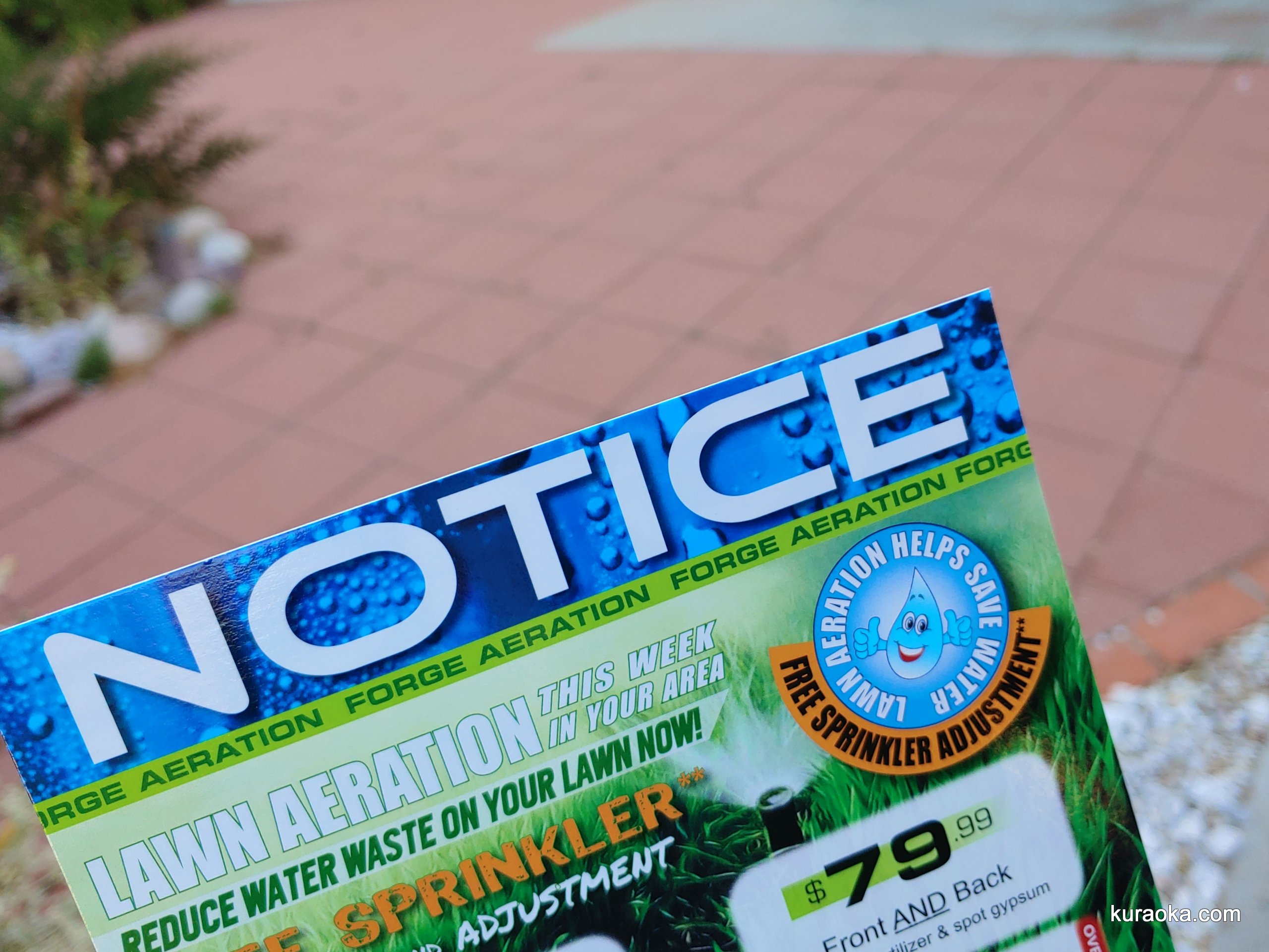
Somehow, I don’t think this gardening firm is getting the targeted reach it wanted for its lawn aeration and sprinkler service. Not only was this flyer tossed onto my fully paved front yard,
but I spotted the same flyer on a neighbor’s equally drought-ready rock garden. How you gonna aerate rocks?
Back to the top of the page
July 22 2019
Researchers studying the alt-right and the “psychology of hate” have landed on something that looks an awful lot like the psychology of branding. Yeah. Told you so. Here’s the
story, from my hometown San Diego Union-Tribune:
Advertising copywriter blog link
The core factors in the rise of hate are identity and fear. And branding is all about that first one, and feeds a fair amount into the second. This is what I’m talking about when I say that advertising is at least partly responsible for the current state of global political affairs – our expertise in creating ever tighter-knit brand communities has resulted in an increasingly fragmented world in which, as I’ve said before, the universe really does revolve around the individual, from the ads they see and the news they read to the communities they join and the feedback they receive.
The very foundation of advertising is the creation of an oversimplified narrative with carefully selected talking points. (Like Calvin of Calvin and Hobbes, I have the same issue with religion.) Brands work to become essential parts of peoples’ identities by fostering a sense of belonging, with a side order of thoughtful superiority. We see it in Apple brand loyalists, but we also see it in devout followers of any particular religious faith, conspiracy theorists, gangs . . . and extremist groups on the right and left.
Identification with a brand is external validation, but it’s also training for externalizing more forms of validation. The more sophisticated advertising and target marketing becomes,
the more dangerous its inevitable outcomes. And at this late stage, no one can call those outcomes “unanticipated.”
Back to the top of the page
January 15 2019
After a lengthy battle with Irish burger francise Supermac’s, McDonald’s loses trademark protection in the European Union for the term Big Mac. Here’s the story, from the Irish Times,
followed by a PDF of the actual EU Intellectual Property Office ruling:
Advertising copywriter blog link
Advertising copywriter blog link
Key point number one: Despite the article focusing on the non-use of Big Mac as a restaurant name, McDonald’s lost all exclusive uses of the term Big Mac throughout the EU, including on its signature sandwich. Now anyone can make a sandwich and market it as a Big Mac.
Key point number two: McDonald’s trademark protection remains strong in the U.S.
What’s mind-blowing is that the EU Intellectual Property Office ruled that all the websites showing the Big Mac, all the marketing materials for the Big Mac, all the menu boards and posters and coupons that were submitted as evidence of genuine use ... didn’t amount to evidence of genuine use.
And this is where either the legal team or the marketing team fatally blundered.
First, the EUIPO discounted the marketing materials because they all came from McDonald’s itself, with no proof of dates of use or data showing that the marketing led to actual sales. Yes, McDonald’s apparently submitted no evidence that anyone looked at an ad or a coupon for a Big Mac and bought a Big Mac. In this day of big data and lead-to-sale conversion tracking, that should’ve been so, so easy to quantify, but it seems no such evidence was submitted.
Second, it looks like no one did any independent research in defense of the trademark. Just a casual street survey (“What do you think of when I say ‘Big Mac?’”) would’ve been conclusive, or at least very strong evidence of the trademark’s existing use and meaning.
In short, McDonald’s seems to have defended its trademark like it was a creative presentation, when it should have made a data presentation.
In the scheme of things, losing the trademark on Big Mac will probably have little impact on McDonald’s bottom line in the EU. It’ll be hard for any restaurant, even Supermac’s projected expansion into Europe, to dilute McDonald’s branding by much.
Yet, I can’t help but be reminded of a small local sub and pizza shop that sells a sandwich called the Better Bird. It’s that shop’s version of a Denny’s menu item called the Super Bird: thin-sliced turkey, melted Swiss cheese, bacon, and tomato on toasted sourdough bread. The Better Bird adds avocado, and, arguably, higher quality ingredients. I like Denny’s Super Bird. But, I like this small shop’s Better Bird better.
If I were a small fast food restaurant owner in the EU, I’d be sorely tempted to work up a burger called the Better Mac.
And if I were McDonald’s, I’d appeal or resubmit the application with better data.
Back to the top of the page
January 7 2019
Most cross-promotional products, like movie tie-ins, come off as forced or, worse, meh. But smart ones can be a lot of fun and good for both brands. Here’s a classic Toyota/Yamaha mash-up,
from 1974, from Ride Apart via MSN Autos:
Advertising copywriter blog link
This was in the heyday of custom vans and motocross, before both went commercial and one eventually petered out. And, this was before Toyota and Yamaha became motoring giants in the U.S.
I remember these Yamahauler ads. And I remember thinking at the time – and I would’ve been around 12 years old then, but very into cars – that it wouldn’t have taken much for Toyota to have put a Yamahauler-like port-of-entry faux-custom into production. A bed kit, wheels, and a lick of paint could’ve made a nice little halo longbed for the brand, much nicer than the SR5 package that came out a year or two later. And it surprised me that no dealers made up their own to sell.
Instead, we had to wait decades for a Ford/Harley-Davidson production pickup, itself not a bad concept and, like the original Yamahauler, spot-on for the times. It’s no wonder it’s coming back for 2019.
But, oh, Toyota could’ve been the first.
Back to the top of the page
Older advertising copywriter blog entries are archived here
Main page | Advertising portfolio | Brochure portfolio | Consumer goods | Eco-friendly products | Food services | Healthcare | Hospitality & tourism | Internet | Manufacturing | Packaged goods | Real estate & construction | Retail & restaurants | Service | Technology
Why should you hire me as your advertising copywriter? | FAQ
Advertising strategy and other lies
An advertising copywriter’s bookshelf:
recommended books
Brands and branding: a white paper
Do you make these mistakes in
advertising?
Free (yes, free) advertising copywriting
resources
Four ad copy traps that ensnare even
experienced copywriters
How to
become an advertising copywriter
How to take your copywriting portfolio to the next level
How to write a brochure: advice from an advertising copywriter
How to write better ads
Long John Silver on writing ads
More career advice: what’s it like being
an advertising copywriter?
Napoleon’s advice to entrepreneurs,
Part I: starting the enterprise
Napoleon’s advice to entrepreneurs,
Part II: the entrepreneurial character
Napoleon’s advice to entrepreneurs,
Part III: growing the enterprise
The ART of repurposing marketing copy (Or, why you shouldn’t use brochure copy as web content)
The economy (and what to do about it)
The Tightwad
Marketing project
When you should consider hiring a freelance copywriter
Advertising copywriting
mentorship
Back to the top of the page
Awards & honors | Curriculum vitae | Services